
A parametric facade uses a clear set of geometric rules to organise a pattern across a building. The rule may change panel size, perforation, depth or spacing, but it still needs to suit the architecture and be practical to fabricate.
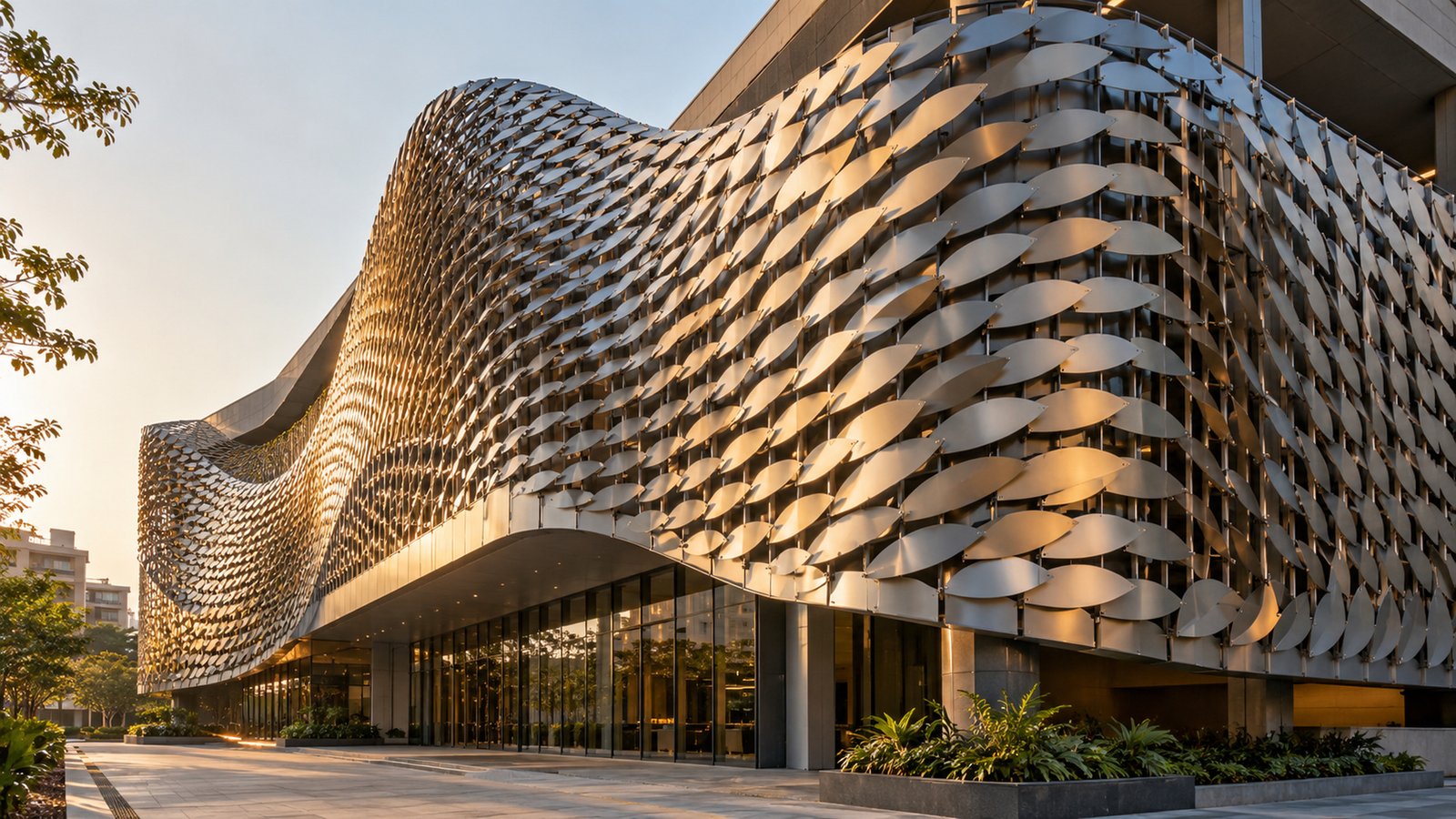
A parametric facade is not decoration by default
The value of a parametric facade is in the relationship between the pattern and the building. A changing screen may respond to openings, create a focal area or give a long elevation a readable rhythm. Complexity alone is not a design brief.
Start with a rule that can be explained
For example, a repeated module may deepen around an entrance or a perforation pattern may become denser where a screen is needed. The team should be able to explain the rule in a sentence. This makes it easier to test the composition and avoid an arbitrary result.
Rationalise the geometry for fabrication
Custom patterns still need workable panel sizes, joints, edges, tolerances and fixing locations. Early coordination helps retain the visual idea while reducing awkward cut pieces and unresolved connections. A digital model is helpful, but it must lead to clear drawings and details.
Review the effect in context
Look at the facade from close range and the main approach. Check how the pattern meets windows, corners and parapets. A sample or mock-up can make the depth, shadow and finish much easier to judge before production.
Next step
See Absteras parametric facade systems, then share your elevation and visual references for a project-specific conversation.
Related Absteras pages
Frequently Asked Questions
What makes a facade parametric?
Its pattern is organised by rules that control repeated or changing elements across the elevation.
Does every parametric facade use perforated metal?
No. Panels, fins, layered elements and other metal components can support a parametric composition.
Can a parametric facade be used on a small area?
Yes. It may be focused on an entrance, balcony screen or selected feature wall.
Why is a mock-up useful?
It helps assess scale, depth, finish and edge conditions in a physical form.