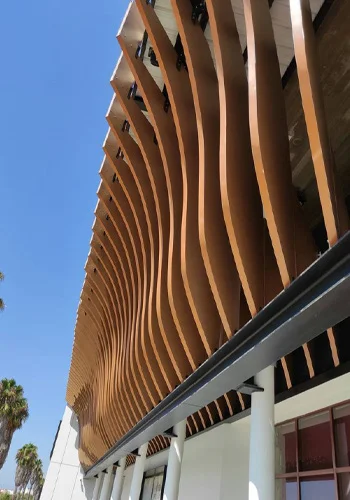
Facade louvers are more than a repeated line on a building. Their depth, orientation and spacing influence how the exterior looks and how much light, shade and screening an opening receives.
Key takeaways
- Louver orientation and spacing should respond to sun direction and viewpoints.
- Profile depth affects both shadow and the perceived scale of the elevation.
- Fixings and edge details are part of the visible architectural result.
-
Begin with orientation
The direction of sunlight and the position of neighbouring buildings help determine where screening is useful. Louvers can then be arranged to support the desired balance between daylight, views and privacy.
-
Find a proportion that fits
Profile width and spacing establish the facade's rhythm. A fine arrangement can feel light and detailed, while deeper or more widely spaced profiles make a stronger architectural statement.
-
Coordinate finish and fixing
Colour and surface finish change how the louvers read against the wall behind them. Their supports and connections should be considered early so the finished elevation remains coherent from multiple viewpoints.
Conclusion
A carefully planned louver system can give a building a clear identity while responding to its specific site and openings.
Frequently Asked Questions
What are facade louvers?
Louvers are repeated profiles arranged on an exterior to create screening, shade and an architectural rhythm.
Can louvers provide privacy?
They can screen selected views, depending on their depth, spacing, orientation and the position of the viewer.
Do louvers block all daylight?
Not necessarily. A louver arrangement can be developed to balance screening with the daylight a space needs.
How does orientation affect louver design?
The direction of sunlight and the location of openings help determine which profile angle and arrangement are worth studying.
What changes when louver spacing is wider?
Wider gaps generally make the screen feel more open and change the balance of shade, views and privacy.
Can louvers be used only around windows?
Yes. They may be placed around individual openings or used as a larger feature across an elevation.
Does louver depth change the appearance?
Yes. Deeper profiles create stronger shadows and a more pronounced sense of dimension.
Can the louver finish match other facade elements?
Finishes can be coordinated with adjacent panels, frames or walls to make the elevation feel consistent.
Why plan the fixings early?
Early coordination helps the support system fit the intended spacing and keeps visible connections deliberate.
Should louver options be viewed from several angles?
Yes. Screens can look more open or more solid from different viewpoints, so multiple views help assess the design.