
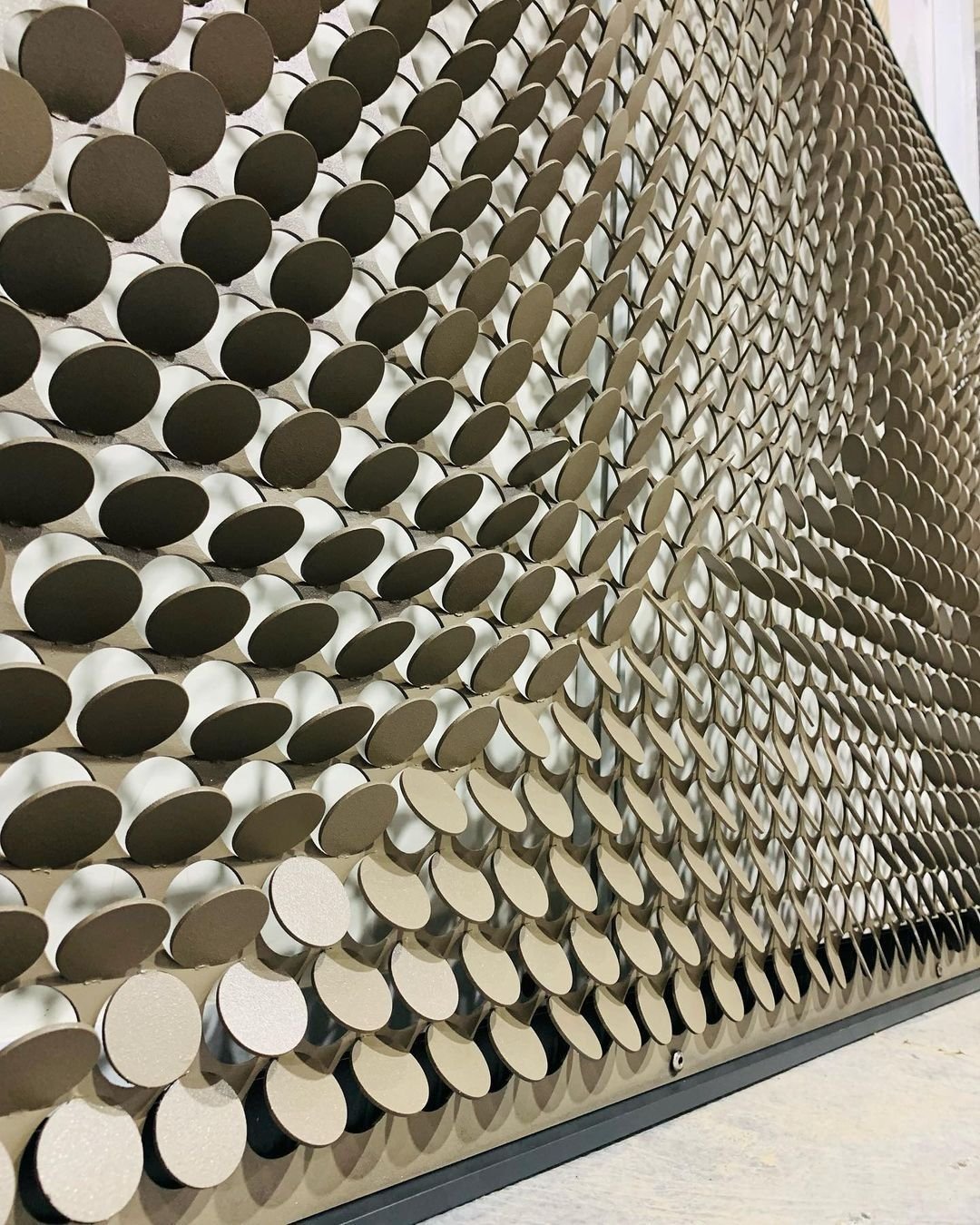
A coin matrix facade uses repeated metal discs to create an expressive exterior surface. As the angle of light changes, the discs produce a varied pattern of highlights and shadows that gives the building a lively visual character.
Key takeaways
- Disc size, spacing and finish control the visual effect.
- Reflection can create change even when discs are static.
- Review the pattern from key street and close-range viewpoints.
-
What is a coin matrix facade?
A coin matrix facade is built from a field of repeated circular elements. The discs create texture through their spacing, depth and finish, while changing daylight produces shifting highlights across the surface. The result can be quiet and uniform or highly expressive, depending on how the pattern is scaled and arranged.
-
Start with the desired visual effect
Before selecting disc sizes or finishes, define the role of the facade. It may be a feature wall that catches attention from a distance, a screen that adds depth to a solid elevation or a transition between larger architectural planes. A clear intent helps establish whether the field should read as a consistent texture, a gradient or a more graphic composition.
-
Study the important viewing distances
A disc field is experienced differently from across a road, at an entrance and from a nearby room. At a distance, the overall density and tonal effect may be most noticeable; up close, individual edges, fixings and overlaps become part of the experience. Reviewing these views helps determine a proportion that works at both scales.
-
Set disc size and spacing together
Diameter, gap and offset are closely connected. Larger discs with wider spacing can create a bolder graphic rhythm, while smaller, tighter modules may read as a finer texture. The selected relationship should be carried through corners, edges and feature zones so the composition feels intentional rather than assembled from unrelated areas.
-
Choose a finish that suits the light
Finish determines how the facade handles reflection and shadow. A softer surface can create a restrained field of tone, while a more reflective finish may make the discs respond strongly to changing sky conditions. Sample panels make it easier to compare colour, sheen and contrast against neighbouring materials before a final decision is made.
-
Decide whether movement is part of the brief
A coin matrix can be visually dynamic even when every element is fixed, simply because light changes across the curved or angled surfaces. Where actual movement is desired, it should be planned as a separate technical decision with appropriate clearances, support and inspection access. The visual idea should remain convincing even when the elements are at rest.
-
Integrate the support system with the pattern
The background frame, attachment points and spacing behind the discs determine whether the finished surface feels precise. Supports should be coordinated with the module grid so they do not interrupt the intended rhythm. Access, drainage and replacement of individual elements are practical considerations that should be resolved before fabrication begins.
-
Prototype the system before the final run
A sample panel or mock-up lets the team assess the effect under real light, verify the apparent density and review edges at a useful scale. It also provides an opportunity to confirm the consistency of disc alignment and the relationship between the visible face and its structural backing. This step makes the final outcome more predictable.
Conclusion
A coin matrix facade succeeds when its visual field and its construction logic are designed together. With careful control of scale, spacing, finish and support, repeated discs can create a memorable surface that changes with the light while retaining a coherent overall pattern.
Frequently Asked Questions
What is a coin matrix facade?
It is a facade surface made from repeated disc-like elements arranged to create a patterned field.
What creates the changing appearance?
The discs catch light from different angles, so highlights and shadows shift as daylight and viewing positions change.
Do coin matrix elements have to move?
Not necessarily. Reflection alone can change the appearance; movement depends on how the individual elements are detailed.
Can the discs form a custom pattern?
Yes. Disc size, spacing, finish and arrangement can be developed into gradients or more graphic compositions.
Does the facade look different up close?
Yes. From nearby, viewers notice individual elements; from farther away, the overall pattern becomes clearer.
Where can a coin matrix facade be used?
It can work as a feature area where texture, reflection and a repeated architectural rhythm are desired.
How is the background structure considered?
The frame and attachment points should be coordinated with the visible disc pattern from the outset.
Can finishes affect the effect?
Yes. Finish and colour influence how strongly the discs reflect light and how the surface reads against its surroundings.
Why review different viewing angles?
A layout that works from one viewpoint may read differently from the street or a nearby building.
What should a project team confirm before fabrication?
Agree on the disc arrangement, support details, intended finish and access for ongoing care.